
The care program that documents itself.
Titra Health ships the cellular devices, watches the readings, records the minutes with an author against each one, and hands your biller a claim with the evidence already attached. Your practice bills under its own NPI.
- No app for the patient
- Append-only time logs
- You bill, not us
Codes the compliance engine computes eligibility for
Why programs fail
Remote care programs don’t collapse on the devices. They collapse on the paperwork.
The scale is the easy part. What costs a practice its revenue — or worse, invites a clawback — is the month where nobody noticed a patient stopped weighing in, the minutes were furnished but never written down, or a claim went out that the record behind it cannot support.
16
transmission days
The gap nobody saw
99454 needs 16 device-transmitted days in the 30-day period. Titra Health counts them as they arrive and prompts the call on day nine — not on the first of the month, when it is already too late.
20
minutes, attributed
The minute that vanished
Minutes furnished but undocumented are minutes you cannot bill. Every log names who did it, what they did, and which month it lands in — computed in your timezone, not UTC.
100%
of lines, evidenced
The claim you can defend
Each billing line carries identity, enrolment, consent, diagnoses and the service record behind that specific code. When an auditor asks, the answer is a file, not a reconstruction.
How it works
Four steps, and only one of them is yours daily.
Enrol the right patients
Upload the practice’s export. Titra Health reads the diagnoses and tells you who qualifies for what. Staff record consent and the ordering provider; nothing ships before that.
The device shows up and just works
A cellular scale is drop-shipped to the patient’s home. No smartphone, no app, no Wi-Fi, no pairing, no account. They step on it and the reading transmits itself.
Your team monitors and documents
Readings land in the chart on arrival. Thresholds raise alerts, the worklist orders the day, and every minute of review or conversation is logged to the patient with an author.
The month closes into a claim
The nightly engine counts transmission days and completed minutes, recommends the codes that actually qualify, and hands your biller a frozen packet with the evidence attached.
The platform
One system from intake to claim, with nothing living in a spreadsheet.
Enrolment
From roster to enrolled, one patient at a time
Import the practice’s patient export, and Titra Health works out which programs each patient actually qualifies for from their diagnoses — instead of asking staff to guess.
More on this- CSV intake matched on chart number, then name and date of birth
- Program fit derived from ICD-10s, with a warning when CCM’s two-condition gate is not met
- Consent and the care plan written in the same transaction as the enrolment
- Coverage re-verified monthly; a plan change flags the patient instead of dropping them
Monitoring
Readings arrive by themselves, and gaps surface early
Cellular devices transmit straight into the chart. Per-patient thresholds raise alerts, and a patient who stops transmitting becomes a task before the billing window closes.
More on this- Vendor-agnostic ingestion behind one adapter — Smart Meter, BodyTrace, Tenovi
- One live alert per patient per rule, with occurrences, so nobody drowns in duplicates
- A caution that becomes critical escalates in place and wakes a snoozed alert
- Alerts are never auto-closed — every one gets a documented human response
Care time
Minutes that are attributable, append-only, and never silently edited
Time is logged against the patient with who did it and what they did. Corrections void and re-insert with a pointer back; the table has no UPDATE or DELETE.
More on this- Role-aware: only physician and clinical-staff minutes count toward 99457 and 99490
- Calendar-month bucketing in the clinic’s own timezone, never a UTC string slice
- Talk to patients through the browser — they see the clinic’s number
- A pre-call plan that weaves open follow-ups, condition prompts and device questions into one agenda
Billing
Claims your biller can defend line by line
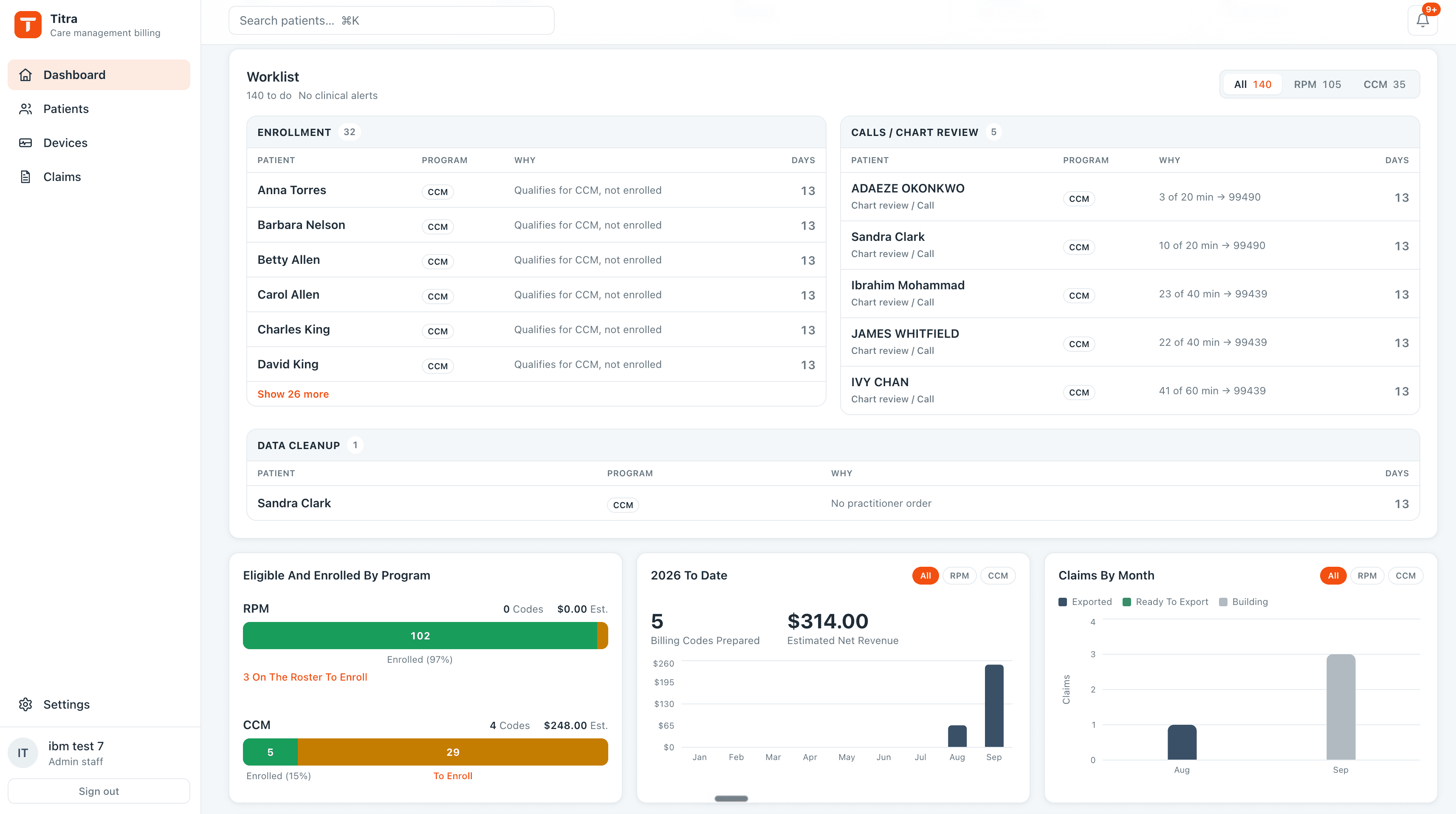
The compliance engine computes eligibility nightly. Every billing line carries the evidence behind it — identity, enrolment, consent, diagnoses, and the service record for that code.
More on this- Transmission-day counts over rolling 30-day device-supply episodes
- Monthly batch submission with a coverage gate that stops claims, not monitoring
- Frozen monthly snapshots — a re-download months later is byte-identical
- Per-patient evidence packets and a clinic roll-up CSV, chart-ready
Size the program
What a compliant month is worth.
RPM, CCM and APCM, priced at CY2026 Medicare rates. Every combination the controls allow is one the rules actually permit — care management is a single choice because APCM and CCM cannot both be billed for a patient in the same month.
Remote Patient Monitoring
A cellular device plus the time spent on what it sends.
Care management
Pick one. APCM and CCM cannot both be billed for the same patient in the same month, and neither can two CCM families — so this is a choice, not a set of checkboxes.
Additional 20-minute blocks99439
Estimated monthly program revenue
$6,800
$170.00 per enrolled patient, per month
- 99454Device supply, 16–30 days$52.10
- 99457Treatment management, first 20 min$51.77
- 99490CCM, first 20 min (clinical staff)$66.13
- Annualised
- $81,600
- Month one incl. set-up
- $7,668
99453Device set-up & patient education — once per episode$21.71
An estimate, not a quote. Figures are CY2026 Medicare national non-facility averages. Your allowed amounts depend on your own fee schedule, your geographic locality adjustment and the payer at claim time, and Medicare cost-sharing applies to the patient. Staff time and Titra Health’s flat per-patient fee come out of this figure. Nothing here is coding or reimbursement advice.
Three programs, each with its own gates.
Built for the enforcement climate
OIG and DOJ are actively pursuing “ship scales and bill 99454” programs.
So the platform is built on one rule: the work has to actually happen, be documented, and be attributable. Titra Health makes that easy and auditable. It never makes it optional.
Patient-reported data can never become a claim
CMS pays the device-supply codes only for data automatically transmitted from a device meeting the FDA definition. In Titra Health, self-reported numbers are clinical context and are structurally incapable of counting toward a transmission day or a billing line. In June 2025 the DOJ settled a case for $1.29M on exactly that fact pattern.
The minutes have to actually happen
Time logs are append-only with staff attribution and a required activity note. Corrections void and re-insert. There are no auto-timer durations, no screen-open time, no event-to-event deltas — the platform makes documenting easy and never makes it optional.
Role matters to the arithmetic
Admin staff can run device logistics and enrolment paperwork, and their minutes are excluded from 99457 and 99490 because CMS excludes them. The engine enforces this rather than trusting the roster.
A snapshot you can still produce in three years
Monthly reports render from frozen snapshots, so a re-download is identical months later. Webhook events are retained forever — that payload is the audit evidence that a reading was device-transmitted.
Built as a business associate from day one
A dedicated AWS account under a signed BAA, KMS-encrypted database in private subnets with point-in-time recovery, no SSH, admin access through Session Manager only, mandatory MFA, and an access log on every PHI read.
You bill, under your own NPI
Titra Health never bills Medicare — RPM management codes are E/M codes and CMS rejected vendor billing. It charges a flat monthly fee per enrolled patient, owed regardless of collections, never a percentage. That is the structure the Anti-Kickback Statute allows.
Also in the box
The unglamorous parts, already built.
Daily clinical worklist
What an NP or MA does today, in the order they should do it — and short enough that it actually gets worked.
Device logistics
Inventory through shipped, delivered, active, returned and faulty, with tracking and a prepaid return path on disenrolment.
Browser-based calling
Single-leg WebRTC calling. You are already on the line by the time the patient’s phone rings.
Call review
Recording, transcription and analysis attached to the encounter, so the minute log has something behind it.
Care plans
A version-tracked comprehensive plan per patient, seeded at enrolment and required before a CCM month bills.
In-app guide
A help panel that knows which screen you are on and nothing else — the route is normalised before it ever leaves the tab.
Charge master & superbills
Your own fee schedule per payer, rendered into a superbill and a claim your clearinghouse accepts.
Access audit
Every PHI read is logged per recipient. Mandatory MFA on every account, and an append-only auth event trail.
You do, under your own NPI. Titra Health is software: it supplies the devices, the monitoring surface, the documentation, and a billing packet your biller works from. The fee is flat and monthly per enrolled patient, owed regardless of what you collect — never a share of collections.
See it against your own panel.
Thirty minutes, screen shared, your diagnoses and your payer mix. We will tell you plainly whether the programs are worth running at your practice.